

In today’s increasingly digital business environment, losing internet connectivity means far more than simply going offline — it can interrupt sales, halt operations, compromise customer service, and generate immediate financial losses.
Many companies still rely on a single internet connection without considering the risks of instability, provider outages, infrastructure failures, or unexpected downtime. When connectivity fails, the entire operation can be impacted.
That’s why internet redundancy has become an essential strategy for businesses that require operational continuity, network resilience, and high availability.
In this article, you’ll understand what internet redundancy is, why it is critical for modern businesses, and how FWA (Fixed Wireless Access) solutions can make redundancy faster, smarter, and more efficient.
What Is Internet Redundancy?
Internet redundancy is the use of a secondary internet connection that works as a backup for the primary connection.
In practice, when the main connection fails — whether due to provider outages, fiber cuts, maintenance issues, or network instability — the backup connection automatically or strategically takes over, preventing the business from going offline.
This strategy helps ensure:
- Business continuity
- Reduced financial losses
- Stability for mission-critical systems
- Reliable remote operations
- Better customer experience and service availability
Businesses that depend on ERPs, CRMs, cloud platforms, remote monitoring, video conferencing, e-commerce, and digital communication systems cannot afford connectivity interruptions.
The Risks of Relying on a Single Internet Connection
When a company operates with only one internet provider or connection, any failure can immediately affect productivity and revenue.
The most common impacts include:
- E-commerce sales interruptions
- Downtime in customer support platforms and cloud communication systems
- Failures in financial systems and ERPs
- Loss of access to security cameras and remote monitoring systems
- Reduced employee productivity
- Operational and financial losses
Studies on business continuity show that even a few minutes of downtime can generate significant losses depending on the size and operational dependency of the company.
How Does Internet Redundancy Work?
Internet redundancy can be implemented in different ways depending on the company’s infrastructure and operational needs.
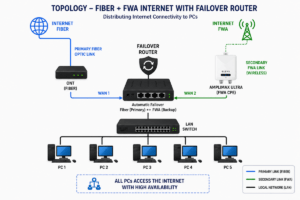
Primary Connection + Backup Connection
One provider works as the primary connection while another acts as the backup.
For example:
- Fiber optic internet as the primary connection
- FWA (4G/5G) as the backup connection
This is considered one of the most effective redundancy strategies because the backup connection operates independently from the wired infrastructure.
Automatic Failover
With the right networking equipment, when the primary connection fails, the system automatically switches to the backup connection without interrupting operations.
This process is known as automatic failover.
Automatic failover dramatically reduces downtime and helps maintain uninterrupted connectivity for critical business operations.
Why FWA Is Ideal for Internet Redundancy
FWA (Fixed Wireless Access) has become one of the most efficient solutions for business internet redundancy because it uses independent 4G and 5G wireless networks instead of relying on traditional wired infrastructure.
In practice:
if fiber connectivity fails, FWA continues operating.
Its main advantages include:
- Fast deployment
- Lower infrastructure costs
- Independence from wired networks
- Ideal performance for urban businesses and remote operations
This infrastructure independence is exactly what makes FWA such a strategic redundancy solution.
Where Is Internet Redundancy Essential?
Industries such as manufacturing, retail, agribusiness, healthcare, logistics, security, financial services, franchises, and remote operations depend heavily on uninterrupted connectivity.
In these environments, losing internet access often means stopping operations entirely.
Businesses can no longer rely on a single internet connection.
Implementing a redundancy strategy means protecting:
- Revenue
- Productivity
- Customer experience
- Operational continuity
- Brand reputation
More than simply avoiding outages, internet redundancy ensures businesses remain operational even during unexpected failures.
And when companies need intelligent, fast, and scalable redundancy solutions, FWA technologies like Amplimax by Elsys become a major competitive advantage.
Amplimax: Reliable Connectivity for Business Continuity
To maximize the benefits of FWA redundancy, businesses need solutions designed specifically for enterprise connectivity and failover environments.
Amplimax by Elsys delivers:
- Stable 4G and 5G connectivity
- Reliable performance in challenging signal conditions
- Fast and simplified deployment
- High-performance connectivity for enterprise applications
More than a networking device, Amplimax helps businesses improve uptime, strengthen network resilience, and maintain uninterrupted operations.
The Future of Business Connectivity Is Hybrid
Modern connectivity strategies are no longer based on a single technology.
Instead, businesses are adopting hybrid network models that combine:
- Fiber optic internet for high-capacity connectivity
- FWA for redundancy and rapid deployment
- Wireless backup solutions for operational resilience
In this model, FWA plays a central role by helping businesses maintain uptime, accelerate deployment, and ensure operational continuity.
Need Smarter Internet Redundancy for Your Business?
Discover how Amplimax by Elsys can help your company implement reliable FWA redundancy, improve network resilience, and maintain uninterrupted connectivity for mission-critical operations.